



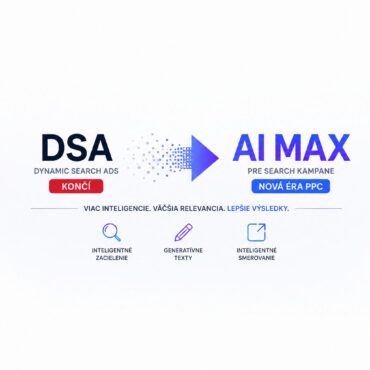
The world of PPC advertising is undergoing one of its biggest transformations in recent years. Dynamic Search Ads (DSA), a long-standing pillar of automation and long-tail query targeting, are coming to a definitive end. Google is replacing them with a new, more sophisticated technology powered by generative artificial intelligence: AI Max for Search campaigns.
For advertisers and e-commerce business owners, this is not merely a cosmetic name change. It represents a structural shift in how the advertising system understands user intent, generates ad copy, and directs valuable paid traffic.
In this article, we will examine the current—and recently postponed—transition timeline, the differences between DSA and AI Max, the risks associated with automatic migration, and the specific steps you should take to prepare your website and Google Ads account without losing performance.
Updated timeline: When will DSA officially end?
Google originally planned to migrate all DSA campaigns automatically as early as September 2026. However, following strong feedback from advertisers who needed more time for testing and wanted to avoid disruption during the crucial pre-Christmas season in Q4, Google announced an important extension of the deadline on 11 June 2026. The current transition timeline is as follows: June 2026 to January 2027 — voluntary migration and testing period: Google has temporarily restored the full ability to create and edit DSA campaigns, giving advertisers enough flexibility to test the new solution. Voluntary migration tools, also known as upgrade tools, are already available in the Google Ads interface. September 2026: The automatic upgrade process begins for campaigns using Automatically Created Assets (ACA) and campaign-level broad match. January 2027: The option to create new DSA campaigns will be permanently removed. February 2027: Automatic migration begins. Google will automatically convert all remaining active DSA campaigns to AI Max.What is AI Max, and how does it differ from traditional DSA?
AI Max is not an entirely new campaign type. It is an advanced package of three AI-powered features integrated directly into existing Search campaigns.Search Term Matching
Unlike DSA, which relied exclusively on static text indexed from landing pages to match search queries, AI Max analyses much more than the landing page. It also considers your existing keywords, creative assets, and complex real-time signals related to user intent. This allows it to cover significantly more complex and unpredictable search queries.Text Customization
AI Max uses advanced generative AI models, such as Gemini, to create personalised headlines and descriptions. While DSA sometimes extracted awkward and unnatural text from websites, AI Max creates ads based on the overall context of the search query, your domain, and your existing assets.Final URL Expansion
Google automatically directs users to the most relevant page on your website, even when it differs from the page originally defined in the ad. This happens when the system determines that an alternative page is more likely to deliver better results.AI Max vs. Performance Max
Many marketers confuse these two terms. Performance Max is a fully cross-channel format that operates across the entire Google ecosystem, including YouTube, Gmail, Google Maps, the Display Network, and other channels. AI Max, on the other hand, is designed primarily for Search-only campaigns as a direct replacement and evolution of DSA. AI Max: three advanced features for Search campaignsThe main risks of automatic migration: Why should you not wait for Google?
Leaving the transition to Google’s automatic migration tool in February 2027 could create serious risks for your business performance. The main risks include:Performance decline during the learning phase
Although Google promises a smooth transfer of campaign settings, AI Max campaigns effectively begin a new learning phase without carrying over the complete and detailed performance history. This commonly leads to a temporary decline in performance and instability during the first two to four weeks.Uncontrolled traffic caused by Final URL Expansion
Under the default settings, Google will fully activate Final URL Expansion after the automatic migration. If your website has a more complex structure, such as an e-commerce store with a blog, parameter-based filters, or pagination, the system may start directing expensive paid traffic to informational pages that do not generate conversions.Cannibalisation of brand campaigns
AI Max naturally tends to look for “easy wins” and display ads for searches related to your own brand name. Unless you define strict brand exclusions in the campaign settings, AI Max may begin competing with your standard brand campaigns. This can artificially increase your cost per acquisition or conversion, known as CPA.Loss of control over existing targeting rules
Old DSA targeting rules, such as “page content contains” or “page title contains,” will become read-only after the transition to AI Max. You will no longer be able to edit them or add new rules. You will only be able to delete them.How to prepare: A step-by-step transition plan
To minimise potential revenue disruption, you should transition to the new format proactively and manually.1. Audit your DSA landing pages now
Review the search terms report for your existing DSA campaigns and focus on the column showing the URLs to which Google actually directed users. Identify blog posts, pagination pages, and filtered pages that consumed budget without generating conversions. Prepare a list of these URLs for exclusion.2. Segment your campaign structure
Visibility.sk recommends building a precisely segmented structure before migration instead of relying on one large catch-all DSA campaign. Divide campaigns and ad groups logically according to product categories or brands. This will allow you to evaluate exactly where AI Max performs well and where it fails. It will also enable you to assign different ROAS or PNO targets to individual campaign segments.3. Set conservative URL rules
When activating AI Max, do not leave everything entirely under the system’s control. Change the Final URL Expansion setting from the full mode to “Only URLs in my webpage targets.” You should also upload a comprehensive list of excluded URLs at the campaign level from day one. Exclude the shopping cart, contact pages, blog, terms and conditions, and any other pages that should not receive paid traffic.4. Use Text Guidelines as guardrails for Gemini
Because AI Max will generate ad copy dynamically, you need to protect your brand reputation. Use the new Text Guidelines section, where you can define up to 25 term exclusions and 40 messaging restrictions. Specify the words that the artificial intelligence must not use and establish clear rules for communicating prices, promotions, and discounts.5. Run campaigns in parallel
Never switch off a stable DSA campaign overnight. The correct approach is to run AI Max campaigns alongside your existing DSA campaigns. Allow the new campaigns to complete their learning process, ideally over four to six weeks. Only after their performance has stabilised should you begin gradually reducing the activity of your old DSA campaigns.Why is AI Max also an important topic for SEO specialists?
The transition to AI Max clearly demonstrates how the boundary between paid advertising and organic search optimisation is becoming increasingly blurred. The structure and technical health of your website are becoming direct factors in the success of your PPC campaigns. AI Max requires a clear and accurate semantic context to function correctly and match search queries effectively. If your website has a chaotic structure, missing H1 and H2 headings, poor-quality content, or confusing navigation, AI Max may generate irrelevant ads and direct traffic to unsuitable pages. To achieve the maximum synergistic effect—successful AI Max campaigns combined with strong visibility in AI-powered search and AI Overviews—focus on the following areas:- A clear and unique purpose for every page, without duplicate content.
- A clean hierarchy of HTML headings and fast website loading times.
- The implementation of structured data, also known as Schema Markup, to provide algorithms with accurate information about products, prices, and reviews.
- Accurate conversion tracking. AI can optimise effectively only when it receives clean, precise, and reliable data about purchases and leads.
 Spotify
 Apple podcasts
 Youtube